
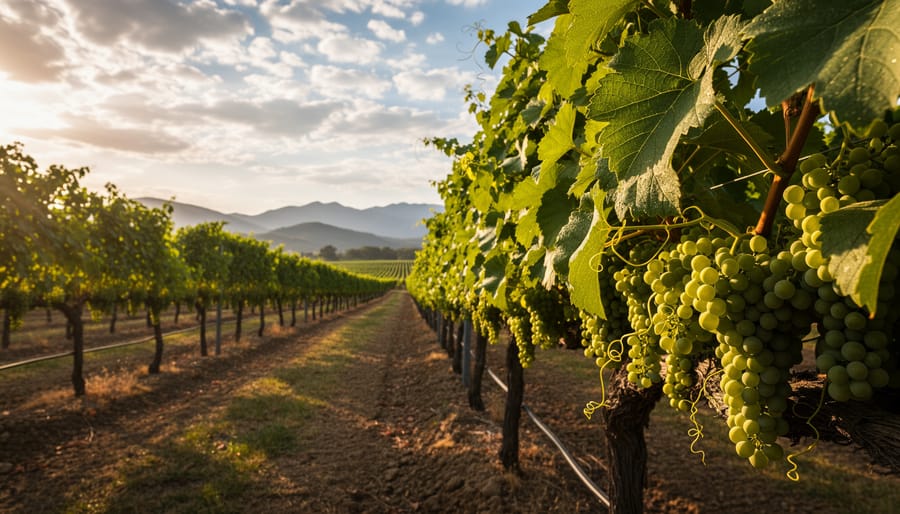
Grapes grow in temperate climates where warm, dry summers allow fruit to ripen fully and mild winters provide essential dormancy without killing the vines. This balance of heat, sunshine, and seasonal rhythm determines not only whether grapes survive, but whether they produce the sugars, acids, and flavor compounds that define quality wine.
Understanding grape climate requirements matters whether you’re planning a vineyard visit, considering a wine country investment, or simply curious why certain regions produce distinctive styles. Grapes are far pickier than most crops. They demand specific temperature ranges, precise amounts of sunlight, and carefully timed rainfall. Too much heat and acidity plummets. Too little and sugars never develop. The difference between a world-class Pinot Noir and watery juice often comes down to a few hundred growing degree days or the timing of autumn rains.
Most premium wine grapes thrive between 30 and 50 degrees latitude in both hemispheres, where Mediterranean and continental climates provide long, steady growing seasons. But within that broad band, microclimates carved by mountains, lakes, and elevation create remarkable diversity. A single valley can host multiple climate zones, each suited to different varieties.
This guide breaks down the core climate factors that make viticulture possible, the main climate types where grapes flourish, and how winemakers adapt to marginal conditions. You’ll learn why certain grapes pair with specific climates and what to look for when exploring wine regions firsthand.
The Climate Grapes Need: Understanding the Basics
Grapes thrive in temperate climates that strike a delicate balance between warmth, sunshine, and seasonal variation. At its core, successful grape cultivation requires a frost-free growing season of at least 150-180 days, daily temperatures consistently above 10°C (50°F) during the growing period, and adequate sunlight to power photosynthesis and ripen fruit. But the specific climate sweet spot varies dramatically depending on whether you’re growing Pinot Noir or Cabernet Sauvignon, Riesling or Grenache.
Temperature drives everything in a vineyard. Grapes need accumulating warmth measured in growing degree days, roughly 850-1,400 GDD for cool-climate varieties, climbing to 1,700+ GDD for heat-loving cultivars. Spring frosts can devastate emerging buds, while autumn cold snaps halt ripening before the harvest window closes. The magic happens in regions where summers provide steady warmth without extreme heat spikes, and where cool nights preserve the acids that give wine its backbone and freshness.
Understanding a few key climate parameters helps decode why certain regions excel at viticulture:
- Growing Degree Days (GDD)
- The cumulative heat units above 10°C during the growing season, determining which grape varieties will ripen successfully. Cool regions accumulate 850-1,400 GDD; warm zones exceed 1,700 GDD.
- Diurnal Temperature Variation
- The daily temperature swing between daytime highs and nighttime lows. Large variations (10-15°C) preserve acidity and develop complex flavors while grapes accumulate sugar during warm days.
- Frost-Free Period
- The number of consecutive days between the last spring frost and first autumn frost. Grapes require 150-200+ frost-free days depending on variety and desired ripeness level.
- Water Deficit
- The calculated difference between rainfall and evaporation during the growing season. Moderate water stress concentrates flavors, but severe drought stunts growth and damages vines.
Precipitation patterns matter just as much as temperature. Most premium wine regions receive 400-700mm of annual rainfall, ideally concentrated in winter and spring rather than during harvest when rain can dilute flavors and encourage rot. Growers in drier climates supplement with strategic irrigation, while those in wetter areas manage canopy density and airflow to prevent disease.
Sunlight duration and intensity complete the climate equation. Grapes need roughly 1,200-1,500 hours of sunshine during the growing season to develop sugars, color compounds, and flavor precursors. Higher latitude regions compensate for lower sun angles with longer summer days, while lower latitudes deliver more intense radiation in shorter bursts.
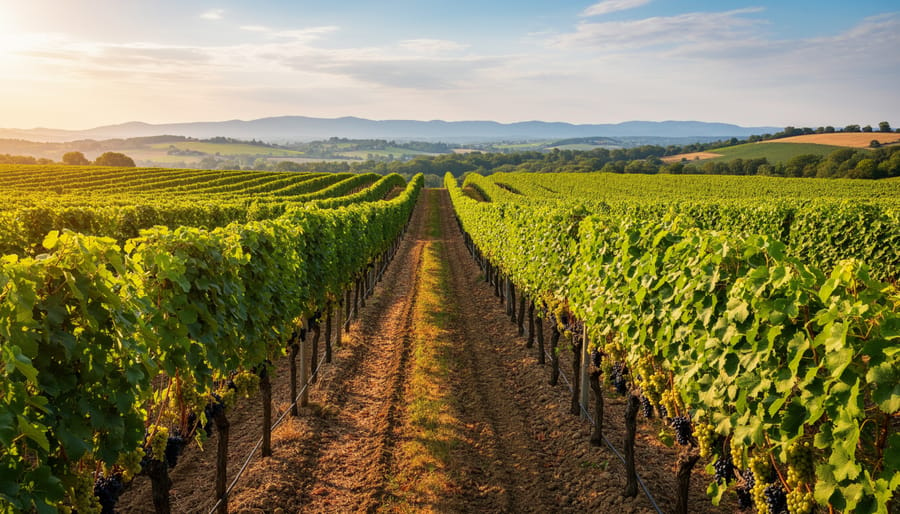
How Climate Influences Grape Development
Temperature’s Role Through the Growing Season
Temperature acts as the primary driver of a grapevine’s biological clock, controlling when buds break dormancy, when flowering occurs, and ultimately when fruit reaches maturity. In spring, consistent warmth above 10°C signals vines to push out new growth. If temperatures spike too early or frost strikes after bud break, the season’s potential crop can be devastated before it truly begins.
Through summer, accumulated heat, measured in growing degree days, determines how quickly grapes ripen. Warm days accelerate photosynthesis and sugar accumulation in the berries. As glucose and fructose concentrations climb, grapes develop the sweetness winemakers need for alcohol production. But temperature doesn’t just build sugar. It simultaneously governs acid metabolism.
Grapes contain two primary acids: tartaric and malic. Tartaric acid remains relatively stable regardless of temperature, but malic acid behaves differently. During warm days, grape cells actively respire, consuming malic acid as an energy source. The warmer it gets, the faster this respiration burns through malic reserves. Hot vintages can strip grapes of the crisp acidity that balances sweetness and gives wines their structure and aging potential.
This metabolic dance explains why harvest timing becomes critical. Growers race to pick when sugar levels satisfy their goals while enough acidity remains to produce balanced wines, a window that shifts earlier in warmer years.
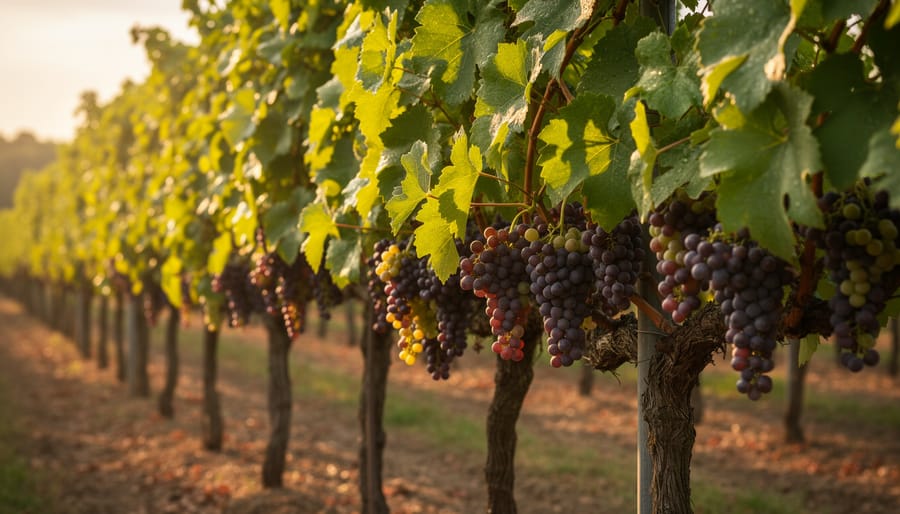
The Sunlight and Water Balance
Grapevines need roughly 1,400-1,500 hours of sunlight during the growing season to ripen fruit properly. Sunlight drives photosynthesis in the leaves, converting carbon dioxide and water into the sugars that accumulate in the berries. More intense sunlight, especially in regions with clear, dry air, generally means faster sugar development and riper flavors.
But water availability determines how efficiently the vine uses that sunlight. Moderate water stress actually improves grape quality. When vines struggle slightly for water during veraison (the ripening phase when berries change color), they divert energy into fewer, more concentrated clusters rather than pumping resources into excessive foliage. The result: smaller berries with thicker skins, more intense flavors, and better tannin structure.
Timing matters enormously. Too much water late in the season dilutes flavor and splits berries. Too little water too early stunts development entirely. Skilled growers monitor soil moisture and apply deficit irrigation, controlled water stress at strategic moments, to balance vine vigor with fruit quality. In the Okanagan, where summer rainfall is scarce, irrigation timing becomes a precise art that shapes whether grapes develop the concentration tourists taste in those bold reds from Naramata Bench.
Why Cool Nights Matter for Acidity
Cool nights slow grape respiration, which is crucial for acid retention. During the day, grapes accumulate sugar through photosynthesis and warm temperatures drive acid metabolism, specifically the breakdown of malic acid through cellular respiration. When temperatures drop significantly after sunset, this respiration slows dramatically, preserving both malic and tartaric acids that would otherwise degrade in sustained heat.
This diurnal temperature variation creates the balanced sugar-to-acid ratio that defines quality wine. The Okanagan Valley has historically benefited from steep temperature swings between warm days and cool nights, particularly in elevated sites like Naramata Bench. However, warming nighttime lows are now compressing this temperature range, accelerating acid loss and pushing harvest dates earlier as winemakers race to preserve acidity before sugar levels climb too high.
Types of Grape-Growing Climates
Cool-Climate Grape Regions
Cool-climate grape regions operate at the edge of viability, where growing seasons rarely exceed 180 days and heat accumulation hovers between 1,700 and 2,400 growing degree days. These areas, northern France, parts of Germany, Oregon’s Willamette Valley, Tasmania, and portions of Canada’s Okanagan, challenge grapes to ripen fully before frost arrives.
The defining trait? Crisp, mouth-watering acidity. Cooler temperatures slow sugar accumulation while preserving malic and tartaric acids that would otherwise degrade in warmer zones. The result is wines with bright, refreshing character rather than jammy richness.
Pinot Noir thrives here, developing delicate red fruit flavors and silky tannins. Riesling produces steely, mineral-driven wines with remarkable aging potential. Chardonnay gains tension and complexity, expressing terroir more clearly than in hotter climates.
These regions demand longer hang time, grapes may take weeks longer to reach optimal ripeness than their warm-climate counterparts. That extended ripening period, combined with moderate sunlight and significant day-night temperature swings, builds flavor complexity while maintaining the structural acidity that makes these wines so food-friendly and age-worthy.
Moderate-Climate Grape Regions
Moderate-climate regions occupy the sweet spot between cool and warm extremes, delivering what many winemakers consider ideal grape-growing conditions. These zones typically accumulate 1,400 to 1,800 growing degree days, providing enough warmth to ripen grapes fully while maintaining the extended growing season that preserves natural acidity and develops complexity.
The Okanagan Valley has traditionally fit this category. Its moderate continental climate combines warm summer days with cool nights, creating the diurnal temperature swing that balances sugar ripening against acid retention. This middle ground supports remarkable versatility, allowing producers to grow everything from elegant Pinot Noir to structured Bordeaux varieties in a single valley.
Moderate zones worldwide, Burgundy, Oregon’s Willamette Valley, parts of Tuscany, share this flexibility. The extended ripening window, often stretching into October, lets grapes develop nuanced flavors and aromatic compounds that rushed ripening in hotter climates can’t match. Adequate but not excessive heat means winemakers rarely need aggressive acidification or alcohol management, producing naturally balanced wines with distinct varietal character and food-friendly structure.
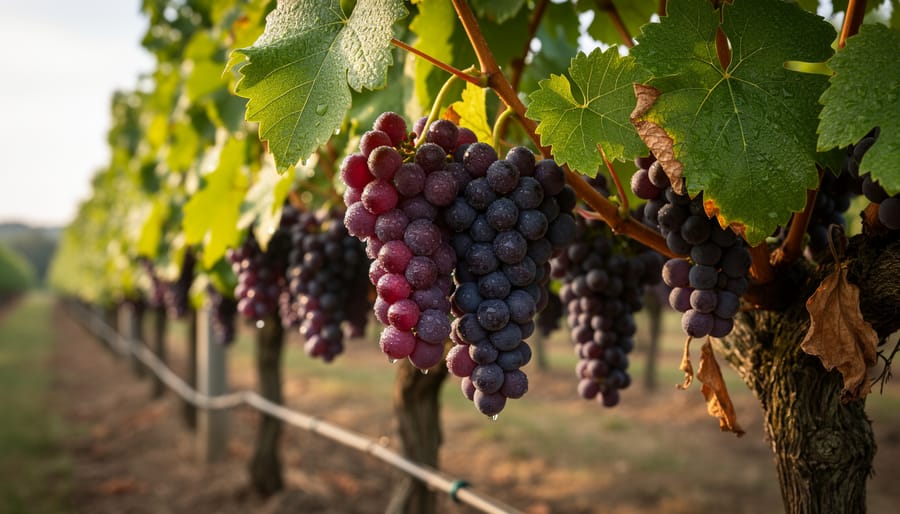
Warm to Hot-Climate Grape Regions
Warm to hot-climate regions accumulate substantial heat during the growing season, typically exceeding 3,000 growing degree days, and produce grapes with concentrated sugars, lower natural acidity, and bold flavor profiles. These areas include parts of California’s Central Valley, southern Spain, Australia’s Barossa Valley, and Argentina’s Mendoza region.
High temperatures accelerate sugar accumulation and advance ripening, often compressing the harvest window. Grapes develop ripe, jammy characteristics with elevated alcohol potential, but malic acid drops sharply in sustained heat. Winemakers in these zones frequently harvest earlier in the morning or use cooling techniques to preserve what acidity remains.
Varieties suited to heat stress thrive here: Grenache, Syrah, Zinfandel, Mourvèdre, and Tempranillo all tolerate high temperatures while maintaining varietal character. Many producers rely on irrigation to manage vine health, as rainfall alone rarely suffices during the growing season.
The wines from hot climates typically showcase dark fruit, full body, and soft tannins, a stark contrast to the bright acidity and lean structure of cool-climate bottlings.

Climate Applications: Growing Grapes in the Okanagan Valley
Golden Mile Bench and Naramata Bench: Climate in Action
The Golden Mile Bench and Naramata Bench exemplify how subtle climate variations create distinct wine personalities within the same valley. Both occupy elevated slopes above Okanagan Lake, but their microclimates diverge in ways that shape what grows best where.
Golden Mile Bench, stretching south from Oliver, sits at roughly 400 to 500 meters elevation on a southwest-facing slope. This orientation captures intense afternoon sun while the elevation keeps nights cooler than the valley floor. The slope drains cold air downward, reducing frost risk during shoulder seasons. These conditions favor heat-loving varieties like Merlot, Cabernet Sauvignon, and Syrah, which accumulate sugars reliably while the elevation preserves acidity. The benchland’s distance from the lake moderates its temperature-regulating influence, creating a warmer, drier pocket ideal for bold reds.
Naramata Bench, running north from Penticton along the lake’s eastern shore, enjoys different advantages. Its gentler east-facing slopes receive morning sun and afternoon shade, moderating heat accumulation. The proximity to Okanagan Lake is key here, the water body stores summer warmth and releases it through fall, extending ripening into October while cooling summer extremes. This thermal stability suits aromatic whites like Riesling and Gewürztraminer, plus Pinot Noir, which all benefit from the slower, more even ripening the lake provides. Diurnal swings remain pronounced, locking in the crisp acidity these varieties demand.
Matching Varieties to Okanagan’s Climates
Okanagan grape growers treat variety selection as a climate-matching puzzle, placing each cultivar where it can fully ripen while retaining the acidity and aromatics that define quality wine. The Valley’s temperature gradient, cooler in the north near Vernon, progressively warmer southward through Penticton and into Osoyoos, creates distinct planting zones that favor different varieties.
Pinot Noir and Riesling dominate the cooler northern reaches and higher-elevation sites, where moderate heat accumulation preserves their characteristic bright acidity and delicate fruit profiles. These varieties struggle in excessive heat, which flattens their flavor complexity. Mid-valley benchlands around Naramata and Summerland support Chardonnay, Gewürztraminer, and Pinot Gris, varieties needing balanced warmth without extreme temperatures.
The southern valley’s desert-like heat suits Merlot, Cabernet Sauvignon, Syrah, and other warm-climate red varieties that require extended ripening to develop full tannin structure and deep color. These grapes would fail to ripen properly in cooler northern sites, producing green, underripe flavors instead of the rich fruit character they’re known for.
Growers increasingly fine-tune these matches using Growing Degree Days calculations and microclimate analysis, recognizing that even neighboring vineyards can differ enough to shift varietal suitability.
Climate Change and Okanagan Grape Acidity
The Okanagan Valley is experiencing the tangible effects of a warming climate, and one of the most measurable changes is occurring inside the grapes themselves. Over the past three decades, harvest dates have crept earlier, ripening has accelerated, and critically, acid levels in grapes have declined. This shift matters because acidity provides the structural backbone of wine, it creates freshness, balance, and aging potential. As temperatures rise, grapes reach optimal sugar levels faster, but the same warmth that drives sugar accumulation also accelerates acid degradation, particularly malic acid, which breaks down rapidly during hot spells.
The mechanism is straightforward. Grapes naturally lose acidity as they ripen through respiration, a metabolic process that consumes organic acids for energy. Higher temperatures speed up this respiration rate. When warm days extend into warm nights, increasingly common in recent Okanagan summers, grapes never get the cool-down period that slows acid loss. Vineyards that once reliably produced Pinot Noir with vibrant, food-friendly acidity now face vintages where the same sites yield softer, less structured wines unless growers intervene. This isn’t a distant, abstract problem. It’s reshaping harvest decisions, variety planning, and winemaking protocols across the Valley’s sub-regions.
Why is grape acidity dropping in warmer climates?
Higher temperatures accelerate the respiration process in grapes, causing them to metabolize and lose organic acids faster, particularly malic acid. Without cool nights to slow this process, acid levels decline even as sugars rise.
How do warmer nights affect wine taste?
Warmer nights prevent grapes from retaining acidity, resulting in wines that taste softer, flabbier, and less refreshing. The loss of acid structure makes wines feel heavier and less balanced on the palate.
What are Okanagan wineries doing to adapt?
Producers are harvesting earlier, shifting to heat-tolerant varieties, using shade management and irrigation strategies to moderate vine temperatures, and employing winemaking techniques like acid additions or selecting cooler sites at higher elevations.
Winemakers are responding with both vineyard and cellar adjustments. Some have shifted harvest timing, picking grapes at lower sugar levels to preserve acidity, then managing alcohol through fermentation techniques. Others are replanting cooler sites or higher elevations with varieties better suited to retain acid in warmth, Albariño and Grenache are appearing where Pinot Gris once dominated. Canopy management has intensified, with growers leaving more leaf cover to shade fruit and moderate berry temperatures. In the cellar, acidulation, adding tartaric acid during winemaking, has become more common, though purists debate whether this maintains the Valley’s authentic terroir expression.
The challenge extends beyond individual vintages. Consistency, a hallmark of established wine regions, becomes harder to achieve when each year brings unpredictable heat patterns. Producers in Naramata and the Golden Mile Bench, areas historically prized for their balanced climates, now face vintage-to-vintage swings that demand constant adaptation. The warming trend hasn’t eliminated the Okanagan’s advantages, the region still benefits from cool nights relative to many wine areas, but the margin has narrowed, and the predictability that growers once relied on has diminished.
how it works
Climate shapes grape growing through an interconnected cycle that begins each spring when soil and air temperatures consistently exceed 10°C (50°F), triggering dormant vines to break bud. As temperatures climb through late spring and early summer, photosynthesis accelerates, sunlight converts to energy that drives shoot growth, leaf development, and eventually flowering. The vines need roughly 100 frost-free days minimum, though premium wine grapes typically require 150-200 days depending on variety.
During this growth window, temperature governs the pace of chemical transformations inside the developing berries. Warmth accumulates sugars through photosynthesis while simultaneously breaking down acids, particularly malic acid. This is where diurnal temperature variation becomes critical: hot days build sugars, but cool nights (ideally 10-15°C cooler than daytime highs) slow acid respiration, preserving the tartness that gives wines structure and longevity.
Water availability acts as the third lever. Moderate stress during veraison, when grapes begin ripening and changing color, concentrates flavors and thickens skins, but severe drought halts ripening entirely. The interplay of these three factors determines harvest timing, when sugar levels, acidity, and phenolic ripeness align for the winemaker’s intended style.
Types or components
Viticulturists classify grape-growing regions into distinct climate categories based on heat accumulation during the growing season, measured in Growing Degree Days (GDD). Cool-climate zones accumulate fewer than 1,400 GDD, producing grapes with high natural acidity and delicate aromatics, think Germany’s Mosel Valley or Oregon’s Willamette Valley, where Riesling and Pinot Noir thrive. These regions often struggle to ripen thick-skinned varieties but excel with early-ripening grapes.
Moderate-climate regions, ranging from 1,400 to 1,700 GDD, offer the sweet spot for diverse viticulture. The Okanagan Valley sits here, alongside Burgundy and parts of northern Italy. This balanced warmth allows steady ripening while preserving crucial acidity, supporting everything from elegant whites to structured reds.
Warm to hot-climate zones exceed 1,700 GDD, favoring bold varieties like Syrah, Grenache, and Zinfandel. Australia’s Barossa Valley and California’s Central Coast exemplify this category, producing ripe, powerful wines with softer acidity. The trade-off? Less vintage variation but reduced freshness and higher alcohol potential.
uses
Understanding grape-growing climates serves several practical purposes. Vineyard owners use climate data to make site-selection decisions, choosing hillside plots for cool-air drainage or valley floors for frost protection. They match varieties to their land’s heat accumulation and frost risk, planting Gewürztraminer in cooler pockets and Syrah where temperatures climb.
Wine tourists benefit too. Knowing that cool climates produce crisp whites helps you plan tastings around your preferences. If you love bold reds, target warm-zone wineries; if you prefer bright acidity, explore northern or high-elevation sites. This knowledge transforms random winery hopping into strategic exploration.
Climate insight also helps collectors and buyers interpret vintage variation. A cooler year yields wines with snappier acids and lower alcohol; a hot vintage brings riper fruit and fuller body. That’s not good or bad, it’s information that guides your cellar choices and food pairings, turning climate from abstract science into tangible enjoyment at your table.
Understanding what climate grapes need gives you the foundation to appreciate how special the Okanagan Valley truly is. This region didn’t become one of Canada’s premier wine destinations by accident, it’s the product of a climate that balances warmth, sunlight, cool nights, and just enough water to coax exceptional fruit from the vines. The microclimates across Golden Mile Bench, Naramata Bench, and other sub-regions showcase how subtle variations in elevation, aspect, and lake proximity translate into distinct wine styles you can taste in the glass.
Yes, the climate is shifting. Warmer temperatures and changing precipitation patterns are reshaping how growers approach their craft. But the Okanagan’s winemaking community has proven remarkably adaptive, adjusting canopy management, rethinking variety selection, fine-tuning harvest timing, and exploring higher-elevation sites. These aren’t panicked responses; they’re thoughtful recalibrations from producers who know their land intimately and are committed to maintaining quality through change.
If you’ve only read about these climate dynamics, experiencing them firsthand transforms understanding into appreciation. Walk a vineyard in August and feel the afternoon heat give way to that crisp evening coolness. Talk with winemakers who can point to specific slopes and explain exactly why that block ripens differently from the one across the road. Taste a flight of Rieslings or Pinot Noirs from different benches and you’ll detect the climate’s fingerprints in every sip.
The Okanagan’s wine story is still being written, shaped by both natural advantages and human ingenuity. The best way to follow that narrative is to visit, explore, and engage with the people and places making it happen.