
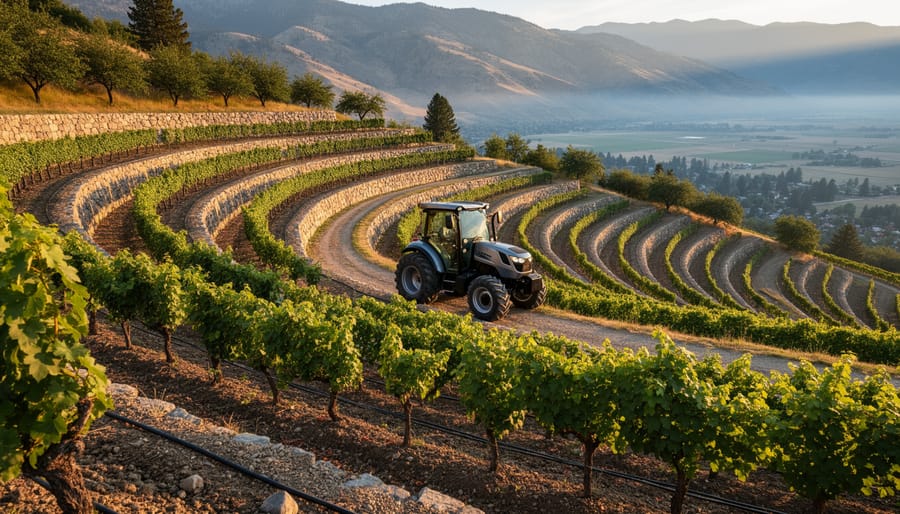
Highland farming transforms steep slopes and elevated benches into productive agricultural land through specialized equipment, terraced planting systems, and soil management techniques adapted to challenging terrain. If you’re wondering how growers coax premium crops from mountainside vineyards or hillside orchards, you’re exploring one of agriculture’s most demanding disciplines.
The practice has gained fresh attention in 2026 thanks to Highland Custom Farming, a Saskatchewan-based operation that’s revolutionizing how farmers approach difficult topography. Their model proves that modern equipment and expertise can make previously marginal land economically viable. They’re not just planting on hills. They’re engineering complete growing systems that account for drainage patterns, frost pockets, and the unique microclimates that elevation creates.
Here in the Okanagan Valley, we’ve been doing highland farming for generations, though we don’t always call it that. Our bench lands, those terraced slopes rising above the valley floor, produce some of Canada’s most celebrated wines precisely because of their elevation. The cooler nights at higher altitudes preserve acidity in grapes. The well-drained soils prevent root rot. The sun exposure on south-facing slopes extends the growing season.
Walk through any Okanagan vineyard clinging to a hillside and you’ll see the equipment challenges firsthand: specialized tractors with low centers of gravity, erosion control measures that double as irrigation systems, and harvest logistics that would terrify flatland farmers. It’s agriculture with a vertical dimension, where gravity becomes both obstacle and ally.
What Highland Farming Actually Means
Highland farming isn’t about relocating cattle to Scottish peaks or abandoning the lowlands. The term captures two interconnected ideas: agriculture practiced on elevated, challenging terrain, and a service-based farming model that emerged to tackle the unique demands such landscapes create.
- Highland Farming
- Agricultural production on elevated terrain where topography, climate variability, and soil conditions create distinct challenges compared to flat, low-lying regions.
- Custom Farming Services
- Professional agricultural operations that provide equipment, labor, and expertise to growers on a contract basis, eliminating the need for individual farmers to own specialized machinery.
- Elevation Agriculture
- Crop and livestock production across varying altitudes, where each elevation band brings different microclimates, frost patterns, and growing conditions that require adapted techniques.
- Contract Growing
- An arrangement where specialized service providers handle specific farming tasks, from planting through harvest, allowing landowners to focus on other aspects of their operation or access capabilities beyond their scale.
The model gained real traction when Highland Custom Farming launched in Grey County in 2005 tackling Ontario’s elevated farmland where shorter growing seasons and rugged topography made equipment ownership prohibitively expensive for many growers. Their approach proved that farmers working challenging terrain could access high-capacity equipment and specialized expertise without the capital outlay of purchasing it themselves.
Why does this matter for the Okanagan? The Valley’s bench lands share highland farming’s core challenge: elevation creates opportunity and complexity in equal measure. From the Golden Mile Bench to Naramata’s slopes, growers navigate frost pockets, varied microclimates, and terrain that punishes standard equipment. What worked in Grey County’s rolling hills offers a template for regions where altitude shapes everything from bud break to harvest timing.
How the Custom Farming Model Works
Highland Custom Farming built its reputation by treating service delivery like infrastructure. Since launching in Grey County in 2005, the company recognized that serious custom farming requires more than a few pieces of rented equipment, it demands permanent facilities that can handle volume, maintain machinery year-round, and scale across regions.
Their Proton Station operation anchors the entire model. The site houses a 1.2 million bushel elevator and weigh station, which means growers can deliver grain directly rather than coordinating separate logistics. An on-site mechanic bay keeps the fleet operational during tight planting and harvest windows, while a dedicated wash bay maintains equipment between jobs to prevent cross-contamination of seed varieties or chemicals. Office and flex space round out the facility, giving the operation room to expand services without relocating.
This setup solves a problem many custom operators face: downtime kills profitability. When a combine breaks during harvest or a sprayer needs recalibration, having mechanics and parts on-site means repairs happen in hours, not days. For the grower, that translates to fewer weather-related losses and more predictable service windows.
Highland Custom Farming’s expansion to Iroquois Falls demonstrates how the model scales. Rather than simply adding more territory to existing routes, they replicated the infrastructure approach in a new region where grain farmers face similar terrain challenges and equipment access barriers. The Dundalk headquarters remains the testing ground for new services, while satellite facilities extend reach without sacrificing reliability.
For Okanagan growers watching this model, the lesson isn’t about copying grain elevators or mechanic bays. It’s recognizing that effective custom farming requires permanent, purpose-built facilities that reduce risk for both the service provider and the client. The question becomes: what would that infrastructure look like in a valley where the crop isn’t grain but grapes, cherries, and apples?
Why Okanagan Growers Should Pay Attention
The Bench Land Advantage
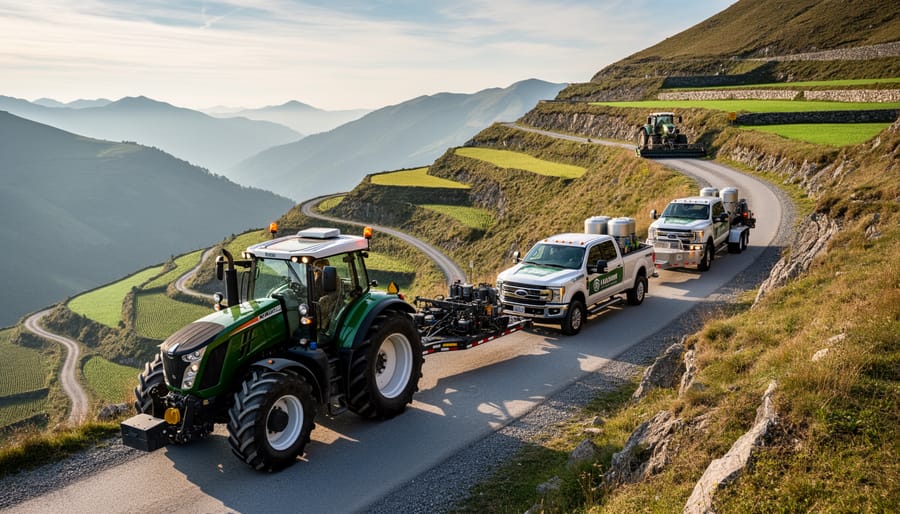
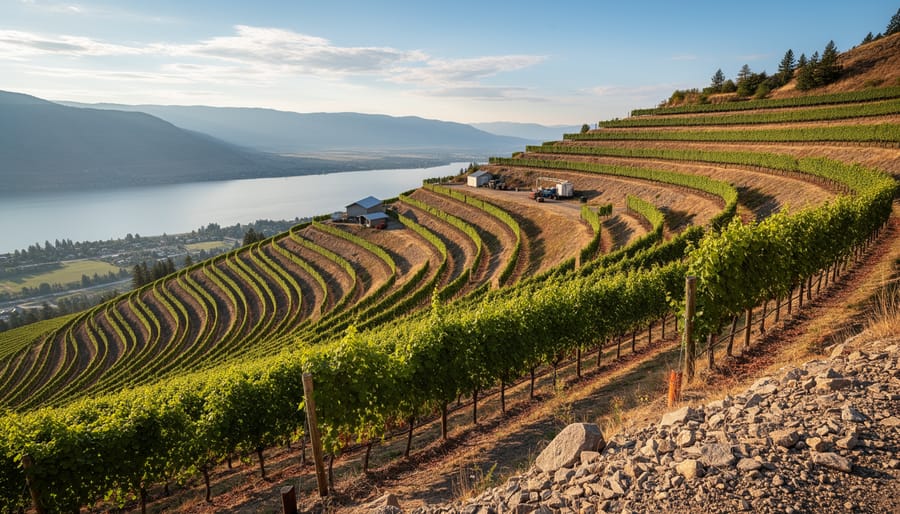
The Valley’s bench lands sit at precise elevations where frost drains away and sunlight lingers longer, advantages that make Okanagan wine distinctive. But these same benches create logistical headaches. Equipment that works beautifully on valley-floor orchards struggles on steep access roads. Tractors built for flat terrain tip dangerously on 15-degree slopes. A single vineyard might span three different elevations, each requiring different timing for spraying, harvesting, or frost protection.
Custom farming services designed for varied terrain could solve this. Instead of every bench-land grower buying specialized hillside equipment they’ll use three weeks a year, a shared service brings the right machines at the right time. One operator with slope-adapted sprayers handles Naramata Bench in spring, then moves to similar terrain in Summerland. Harvest equipment calibrated for elevation changes works Golden Mile properties without each owner carrying the capital cost. The bench lands’ natural advantages stay, but the operational disadvantages shrink when expertise and equipment move efficiently across similar elevated sites.
Equipment Access Without the Investment
Purchasing specialized vineyard equipment for the Okanagan’s hillside terrain means a six-figure investment that sits idle much of the year. A narrow-track tractor suitable for bench land slopes costs $80,000 to $150,000, while the attachments for spraying, mowing, and harvest operations add another $30,000 to $60,000. Small growers working ten to twenty acres can’t justify that expense when the machinery runs perhaps thirty days annually.
Custom farming services flip this equation. Instead of one grower shouldering the full cost, equipment spreads across dozens of operations. A five-acre estate vineyard pays only for the days it needs specialized hillside sprayers, not the purchase price plus insurance, maintenance, and storage. The savings compound for operations producing both wine grapes and soft fruit, where different crops demand different machinery at different times.
This model already props up Okanagan wine production in informal ways: neighbors share equipment, larger estates rent to smaller ones, and some growers co-own machinery. But the approach remains patchwork. A formalized custom service offering scheduled access to slope-rated tractors, pneumatic sprayers calibrated for bench land microclimates, and harvest equipment sized for tight vineyard rows would let mid-size operations scale up without the capital outlay that currently blocks expansion.
Could This Model Take Root in the Okanagan?
The leap from Ontario’s grain fields to the Okanagan’s terraced vineyards and orchards isn’t straightforward, but elements of the custom farming model could adapt to the Valley’s unique needs. Highland Custom Farming’s success with row crops and commodity grains operates under fundamentally different economics than specialty fruit and wine grape production. You can’t simply transplant a 1.2 million bushel grain elevator model to a region where a five-acre benchland vineyards might produce 15 tonnes of Pinot Noir worth more per acre than 100 acres of wheat.
- Addresses equipment cost barriers for small growers who need specialized vineyard or orchard machinery only seasonally.
- Could provide expertise in managing steep terrain and varied microclimates that many new growers lack.
- Allows operations to scale without major capital investments in machinery that sits idle most of the year.
- Potential for shared storage, processing, or packing infrastructure similar to Highland’s elevator model.
- Wine grapes and tree fruit demand far more precision and varietal-specific handling than commodity grains.
- Okanagan’s narrow growing corridors and dispersed bench lands create logistical challenges absent in consolidated Ontario farmland.
- Existing packing houses and wineries already serve some cooperative functions, reducing the service gap.
- Regulatory differences between BC and Ontario agriculture, particularly around wine production, complicate direct model transfer.
The infrastructure requirements alone present obstacles. Highland Custom Farming built its Proton Station facilities in an area with available industrial land and grain marketing channels. The Okanagan’s agricultural land reserve restricts development, and the region lacks the grain handling infrastructure that makes Highland’s model viable. What could work are more targeted services: shared vineyard equipment pools for canopy management, precision spraying cooperatives for hillside orchards, or seasonal labor coordination across multiple bench land properties. A few custom operators already provide harvesting services, but nothing approaching Highland’s comprehensive model exists yet. The question isn’t whether an exact replica will emerge, but whether Okanagan growers will develop their own version tailored to permanent crops, premium products, and the Valley’s distinctive geography.
What Okanagan Farmers Are Already Doing
Okanagan growers have long practiced their own version of collaborative farming, though they might not call it a custom service model. Equipment sharing among neighboring orchards happens quietly every harvest season. A vineyard owner with a mechanical harvester lends it to three smaller operations down the road; an orchard with specialized spraying equipment offers weekend rentals to farms that can’t justify purchasing their own. These informal arrangements keep costs manageable and equipment utilization high across valley vineyards and fruit operations.
The BC Fruit Growers’ Association facilitates some coordination, connecting members who need specific machinery with those who have excess capacity. Packinghouse cooperatives have operated in the Valley for decades, pooling resources for sorting, storage, and distribution. Some wineries share mobile bottling lines. A handful of contractors offer specialized services like frost protection, netting installation, and harvest labor management, but these tend to be seasonal and task-specific rather than comprehensive farming operations.
What’s missing is the integrated approach Highland Custom Farming offers in Ontario: a single provider handling everything from planting through harvest with dedicated facilities and year-round staff. Okanagan’s custom services remain fragmented. You might find someone to prune your vineyard and someone else to harvest it, but coordinating multiple contractors across a season creates administrative headaches. Equipment sharing works until three neighbors need the same harvester the same week.
The gap becomes obvious on bench lands where terrain demands specialized machinery. Small operations on Naramata Bench or Black Sage Road often delay equipment upgrades because steep slopes require different attachments than valley floor farms. A formal custom farming service designed for the Valley’s elevation challenges could fill that void.
Highland Custom Farming’s two-decade journey from a single Grey County base to a multi-site operation with sophisticated infrastructure proves that specialized service models can thrive where terrain demands expertise. While the Dundalk operation focuses on grain crops rather than grapes or stone fruit, the underlying principles translate directly to the Okanagan’s bench lands and valley floors. Growers here already understand terrain challenges; what’s missing is the formalized service infrastructure that makes specialized equipment and know-how accessible without prohibitive individual investment.
The Valley won’t replicate Highland Custom Farming’s exact model, nor should it. But as labor tightens and equipment costs climb in 2026, the custom farming concept offers a proven template. Cooperative equipment sharing, terrain-specific service providers, and scalable operations that serve multiple properties could address real gaps in Okanagan agriculture. The question isn’t whether highland farming principles apply here, the bench lands prove they do. The question is which local operators will step forward to build services that match the Valley’s unique crops, terrain, and growing community of growers who need better access to solutions that work on challenging ground.